


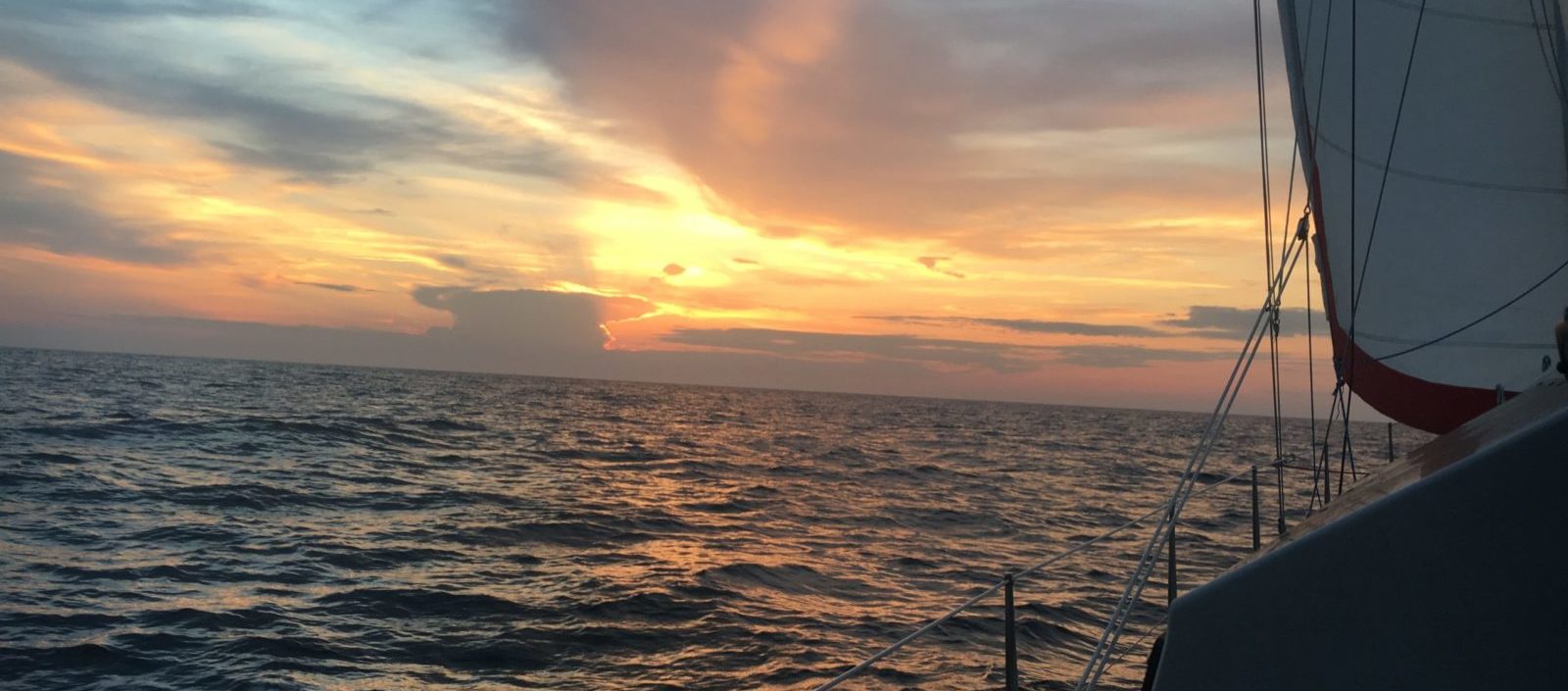
So, we are anchored in Loch Spelve waiting out a powerful Low Pressure system. The winds are honking around 30 knots and it has been raining buckets off and on for two days. So I thought I’d take some time to show you around our floating domain and share some of the things we have to keep us going from day to day.

We’ll start with a tour of the boat. Zephyr is 60 feet long, but the cabin doesn’t begin til 10 feet aft of the bow. The forward section is the fore peak, we call it the attic. We store an asymmetrical spinnaker, a gennaker, storm sails, drogues, lines and rigging spares in here. 300′ of 3/8″ anchor chain stows below attached to a 124# Bruce anchor, handled by a Maxwell electric windlass. We also stow two additional anchors and extra rode in the attic. It is tall enough to stand in and work around. It is separated from the cabin by a water-tight bulkhead.


Next we move inside; forward is our deluxe suite with queen-sized bed with storage underneath. The lift-up was fabricated by myself to make access easier. On either side are clothes lockers and Nancy has a make-up mirror and vanity sink on her side. Also in the master suite is our large shower.


Farther aft is the main saloon with 7′ settee to starboard and L- shaped settee with table to port. Beneath these is storage for bulk supplies. Outboard I have built bookshelves and wine and spirit lockers for the occasional cocktail. Also a cabinet for Nancy’s art supplies. The artwork on board is Nancy’s.


Aft of the saloon is the galley to port with a double sink, fridge and freezer, stove/oven/broiler, microwave oven, blender, Soda Stream, bread maker, and storage for pots, pans and dishes as well as pantry drawers for easy access to common items. The galley is perfect for preparing meals at sea and even better when at anchor with friends to help cook since several people can work around the L-shaped space.


Below is a sample of the meals we eat on board in a typical week:


Then to starboard is the navigation station with full instrument repeaters as well as IMAC, SSB radio, VHF radio, AIS, radar, Starlink and all electrical, charger, inverter controls/monitors. We also have a great Marantz stereo system for the cabin and cockpit for dancing in the moonlight.

Aft of the galley is what we call the kid’s room. Two twin bunks which we use when on passage. They are the most comfortable beds in a seaway as well as being within hailing distance of the crew on watch. It has shelves and a hanging locker for crew gear.

Behind the nav station is our main head. Inside is a toilet, sink (which also has a shower hose), vanity storage and, best of all, a washer/dryer combo!


If we move up the companionway (stairs) we enter the doghouse, our enclosed watch keeping/lounging space. It is long enough to lie down and stretch out. It holds the chart plotter and other instruments and keeps us warm and dry while sailing in inclement weather.

Aft is the helm station with two captain’s seats for comfort when hand-steering. Beneath all this is the engine room and aft lazarette we call the garage. These spaces are separated from the cabin by a water-tight bulkhead.


The engine room contains a Yanmar 126hp turbo-diesel a 20 gallon water heater and a work bench with vise and drill press, bilge pumps, water pumps and fridge/freezer compressor/condenser units.


In the garage are the desalinator which makes 32 gallons of fresh water per hour, the 8kw generator, hydraulic auto pilot with duplicate backup unit, A/C unit, heater, dive compressor and SCUBA tanks. It also houses the controllers for the wind and solar power units. The Webasto heater is diesel-fired and burns about 1Tbs/hr. It is a hydronic boiler which heats fluid which is pumped through the water heater and then throughout the cabin where fans blow warm air onto my tootsies. The engine, when running, also flows hot exhaust water through the water heater to make hot water for dishes and especially glorious showers!


So, how do we make all this run? We have four 120 watt solar panels and a D 400 wind generator as well as a Watt and Sea hydro-generator when we are under sail.


These generally produce all the power we need to keep our 1200 amp-hour battery bank fully charged. No we’re not on the lithium bandwagon. We still use AGM batteries, thank you very much and are totally satisfied with them. If the sun and wind aren’t cooperating we can charge with the 200amp alternator on the main engine while motoring, or with the 8kw Fisher Panda generator. We use the generator when doing laundry, making water, and filling SCUBA tanks. It has the power to do all at the same time. Oh yes, the sails are all controlled by electric winches.
As for fuel consumption; well, we can motor with no wind or sails at 6 knots at 1800 rpm burning 1 gph. Which is quite good actually. This is due to the narrow beam and limited displacement of the hull. The generator also burns 1gph when in use. We carry 250 U.S. gallons of diesel in two tanks outboard of the engine. We also have a 9′ 10″ aluminum hulled RIB with a 15hp Tohatsu four-stroke outboard to get around when we’re at anchor. With the help of my dad, we fabricated a gin pole type hoist to lift it on deck. In operation, it takes just a few minutes and eliminates all strain on my old body. We also have an Epropulsion Spirit Plus electric outboard for those ultra quiet moonlight rides! For those rough days the dinghy even has a custom dodger to keep Nancy dry and comfortable.

For sailing Zephyr, we have a large main with a broad roach at the top that rises 70′ above the water, so we have lots of power. She, and we, prefer to sail flatter, so we generally put in the first reef, a small one, at around 20kts apparent. The second goes in about 25 and the third around 35. We seldom lose boat speed when we reef unless we want to twist the sail. The main is fully battened, attached to Battcars and with two-line slab reefing we don’t head up to reef. This is safer and the boat doesn’t wallow. All lines lead to the cockpit so we are side-by-side when reefing, raising, or lowering the sail. It makes communication calm and easy. The sail nets into a lazy jack-type sail cover. Stowing is a cinch.

The jib is a 100% radial cut on a roller furler with reefing pads so it sets beautifully even if partially furled. If the waves are tall we often eliminate the jib and set the staysail. It keeps the power closer to the center of effort and smooths out the ride. It also sets on a roller furler.

When the wind is moderate, say ten to 12 kts apparent and from 70-110 degrees, we will set the new gennaker. It is a lovely sail that sets from the bowsprit on a top-down wire furler. It is a joy to see. Unfortunately we haven’t had a chance to use it here as the wind hasn’t favored it much. Finally, there is the delightful asymmetrical spinnaker; if the wind is light and from behind it sets from a sock and pulls us along beautifully with bright colors and easy smiles. We had it up the other day. All from the convenience of the cockpit.


Well that’s about all there is. Zephyr is a really simple boat when you get right down to it. She usually steers herself under main and jib or staysail, so underway life is pretty good. I hope this fills in the picture you may have in your mind about life aboard. Well, Nancy’s preparing Duck a l’Orange for dinner and I must set the table.

Warren
irene
Tracey Wade
Robert kellam
Chris
Darlene